A Western Saharan diplomat has condemned New Zealand’s purchases of the territory’s fertilisers from Morocco.
Pacific Media Centre
22 August 2008
By Katie Llanos-Small
Buying phosphates and fertilisers from Morocco supported the illegal occupation of Western Sahara, says Mohamed Beissat, the territory’s Foreign Affairs Minister for Africa.
“We hope New Zealand will stop these shipments,” Beissat says.
Western Sahara has campaigned for independence since the 1970s when the Spanish colonial power moved out and Morocco took control.
The territory is rich in fish, phosphates, gas and petroleum.
Beissat visited New Zealand en route to this week’s Pacific Islands Forum in Niue where he was due to meet leaders and put forward the case for official recognition of the territory.
Many Pacific Island nations are sympathetic to the Western Saharan cause because they had also gone through colonisation and decolonisation, he says.
Vanuatu recently established diplomatic links with Western Sahara.
East Timor and Papua New Guinea also recognise Western Sahara as an independent country.
Beissat describes the Moroccan occupation as “a very simple case of justice and of peace”.
The ‘listed’ 16:
• Sixteen countries are on the United Nation’s decolonisation list.
• Ten are administered by Britain - Anguilla, Bermuda, British Virgin Islands, Cayman Islands, Falkland Islands, Montserrat, St Helena, Turks and Caicos Islands, Gibraltar and Pitcairn.
• Three are administered by the US - US Virgin Islands, American Samoa and Guam.
• France (New Caledonia), New Zealand (Tokelau), and Morocco (Western Sahara) each administer one.
• Spain took control of Western Sahara in the 19th century and remained there until shortly before dictator Francisco Franco’s death in 1975.
• Morocco and Mauritania then took control of the region. Mauritania withdrew in 1979 and Morocco filled the vacuum. A referendum needed to be held to give Western Saharans the choice of remaining part of Morocco, seeking autonomy or becoming an independent country, he says.
“It’s more fair, more just, more democratic to give people the choice.”
Western Sahara has been on the United Nations’ decolonisation list since 1990. The 16 countries on the list are “non-self-governing territories” to be helped toward independence.
Beissat believes it is “outrageous” that global powers helped Kosovo to independence, when the province was not on the UN’s decolonisation list.
“We were surprised by the double standards displayed by the superpowers,” Beissat says.
“We think priority should be given to the 16 countries on the UN decolonisation list.”
Beissat is one of 160,000 Western Saharans who live in desert refugee camps in neighbouring Algeria.
People there live in tents or in mud huts. There are schools and hospitals, and water and gas for cooking, but no electricity.
Beissat met unofficially with politicians from Labour, the Green Party and the Maori Party while in New Zealand.
Katie Llanos-Small is a Graduate Diploma in Journalism student journalist in AUT University’s School of Communication Studies.
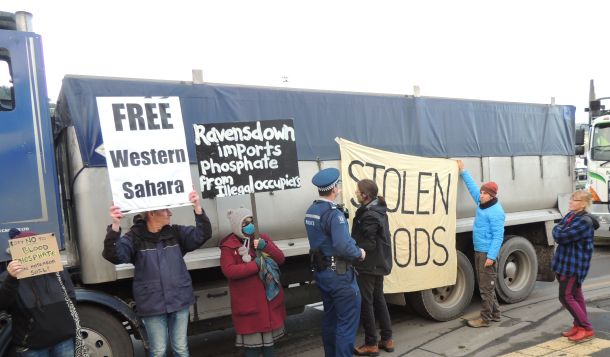
Protesters set up roadblock to stop conflict minerals in New Zealand
The pressure is mounting on the New Zealand importers of phosphate rock from occupied Western Sahara. Today protesters in Christchurch erected roadblocks to stop trucks from transporting the conflict minerals into the local Ravensdown fertiliser factory.
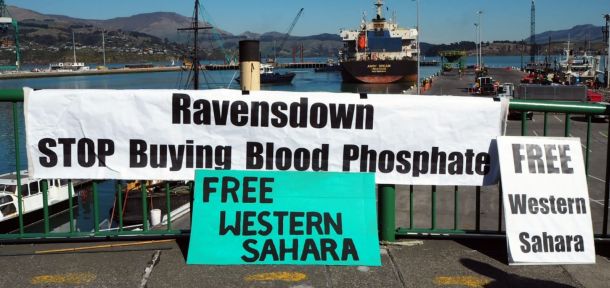
Kiwi importers ignore government advice on Western Sahara
While other companies internationally have managed to find alternative sources of phosphate - and in spite of a request of the New Zealand government that they do the same - the Kiwi fertilizer industry seems unwilling to drop its imports from occupied Western Sahara.
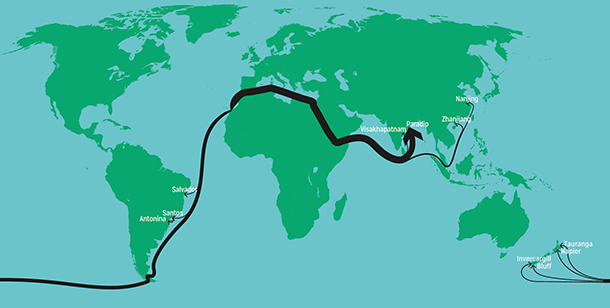
New report: Western Sahara phosphate trade halved
The export of phosphate rock from occupied Western Sahara has never been lower than in 2019. This is revealed in the new WSRW report P for Plunder, published today.
Flotilla targets phosphate plunder ship
A Japanese-Canadian vessel that transported conflict phosphate from occupied Western Sahara was yesterday received by a floating protest in New Zealand.